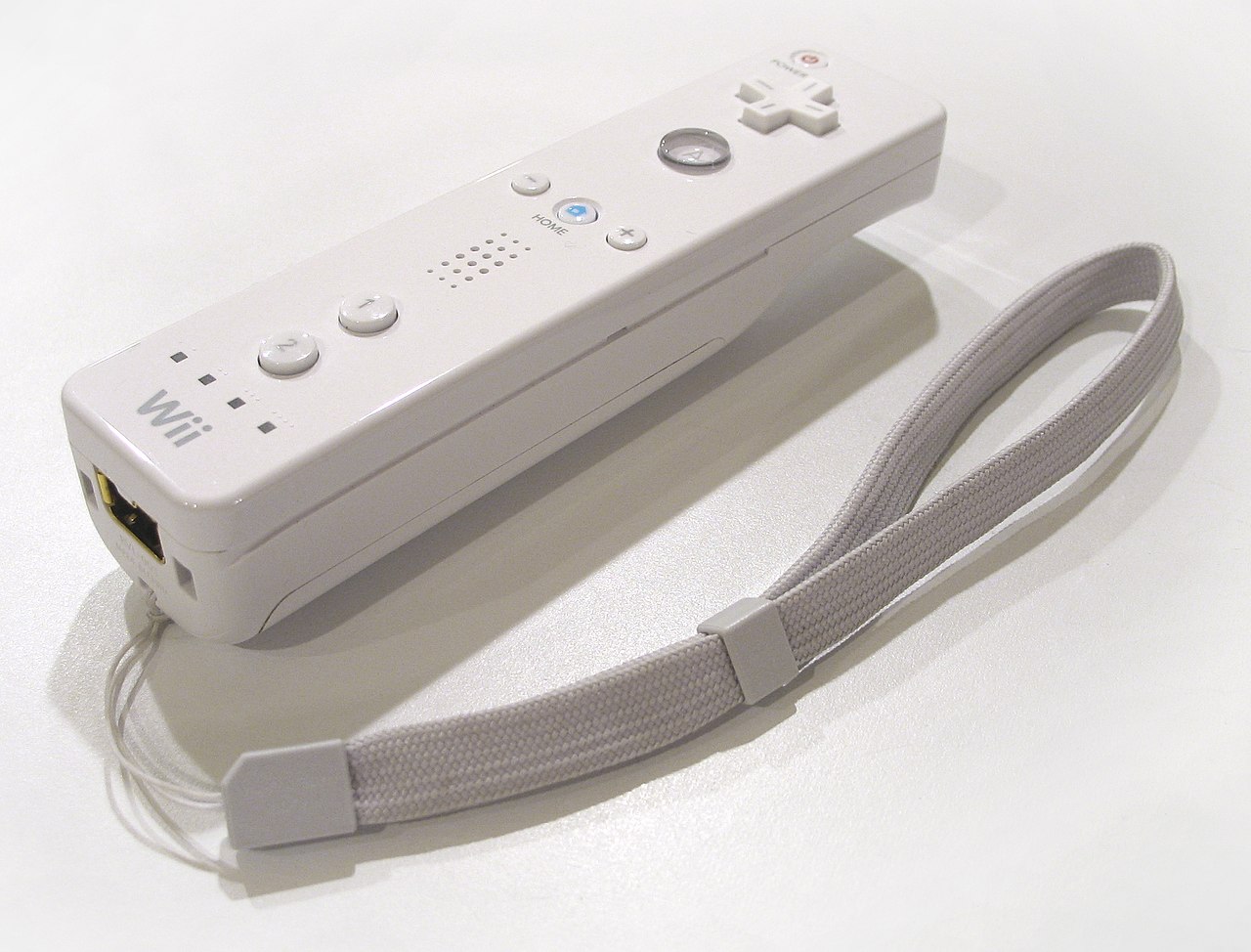
In April 2006, the gaming press lit up with one of the most unlikely announcements in the history of video games: Bob Ross was getting his own game.
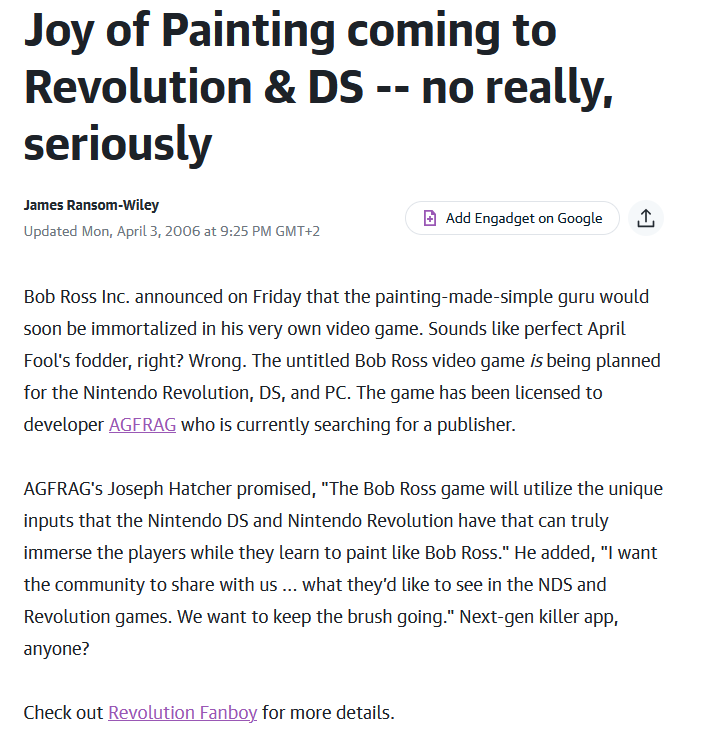
Not a parody. Not a fan project. An officially licensed, commercially planned video game based on "The Joy of Painting" — the PBS television show that had made a soft-spoken former Air Force sergeant into one of the most beloved figures in American culture. The game was being developed for Nintendo's upcoming Wii console, the Nintendo DS and PC.
It was never released. And the story of why it wasn't — and why the concept was ahead of its time — says something important about the intersection of art, technology and timing.
The Studio: AGFRAG Entertainment Group
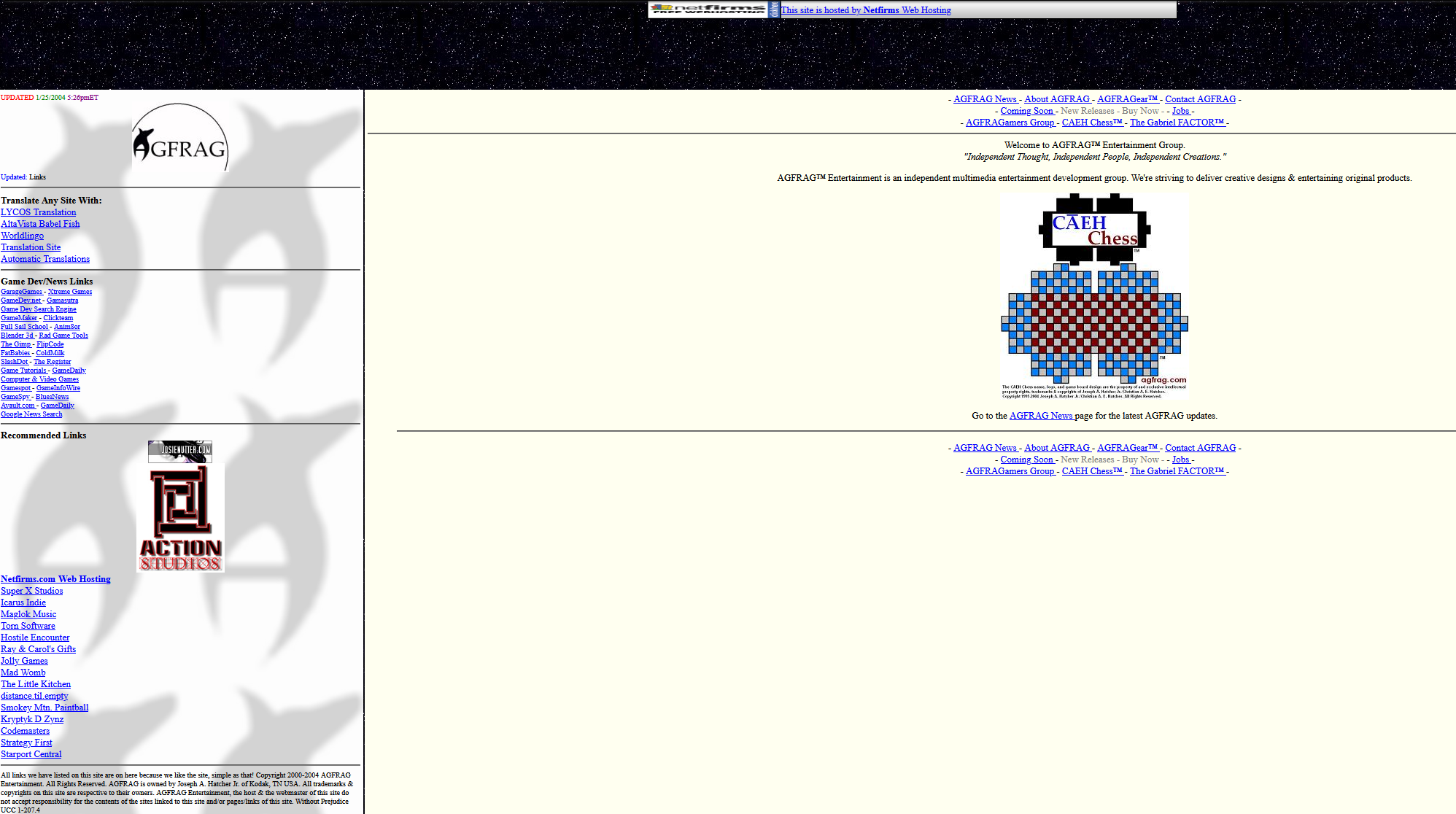
The developer behind the project was AGFRAG Entertainment Group, a small independent studio founded by Joseph Hatcher under the banner of Hatcher Technomantics. Based in the United States, AGFRAG was focused on creative and puzzle-oriented games — a niche that made the Bob Ross license a natural fit.
AGFRAG wasn't a household name. It wasn't backed by a major publisher or funded by venture capital. It was the kind of studio that defined early indie game development: small, ambitious and operating on passion as much as budget. The company's web presence lived right here, at agfrag.com.
What AGFRAG lacked in resources, it made up for in creative vision. The studio understood something that larger publishers might have missed: Bob Ross wasn't just a personality to be slapped onto a product. He was a philosophy — an approach to creativity that could genuinely translate into interactive entertainment.
Internal documents from the period describe AGFRAG's scope as broader than most observers realised. The studio's official motto was "Wild Creativity" — and its activities extended well beyond games to include music publishing, books, websites and board games. AGFRAG also served as a publisher for other independent creators, helping them distribute their work across various platforms.
The AMN interview also revealed two other projects in development at the time: a puzzle game called Gami Jami and a children's book titled Sippies Two Teeth Trouble — confirming that AGFRAG saw itself as a multimedia creative studio, not just a game developer.
The Concept
The game's design was built around the three platforms it targeted, each offering a different way to interact with the painting experience:
- Nintendo Wii: The console's motion-sensing remote would serve as a virtual paintbrush. Players would make physical painting motions — broad strokes for sky, gentle taps for foliage, precise movements for detail work — while Bob Ross guided them through the process.
- Nintendo DS: The handheld's touchscreen and stylus provided a more direct painting experience. Players would draw directly on the screen, using the stylus as a brush or palette knife.
- PC: Traditional mouse and keyboard controls, with the option for drawing tablet support.
Critically, AGFRAG had secured comprehensive rights to Ross's creative legacy. According to coverage at the time, the studio had access to "full rights to all of the transcripts, all of the audio archives, all of the paintings." This wasn't a game that would feature a generic Bob Ross impression — it would include his actual voice, guiding players through the painting process just as he had on television.
The developers spoke about wanting to "allow fans to paint with him" — a goal that captured the spirit of The Joy of Painting perfectly. Ross's show had always been about participation, not passive viewing. A game that let players actually paint alongside him was the logical next step.
The earliest coverage also hinted at gameplay beyond simple painting. The first article to break the story — published on March 31, 2006, the same day as the press release — noted that the game would feature not only tutorial-based painting but minigames as well, suggesting a more varied experience than a pure art simulator.
A May 2006 interview via GoNintendo revealed further technical details. AGFRAG had been granted access to Bob Ross's complete television archive spanning 1982 to 1993, including voice recordings and transcripts in all the languages the show had been broadcast in — potentially enabling future localisation. Between five and fifteen publishers had already approached AGFRAG with interest in the project. On gameplay, Hatcher described a vision of radical simplicity: "Turn it on, and start playing the game."
An April 2006 interview with AMN (Advanced Media Network) confirmed several key details directly from Hatcher. Bob Ross's real voice would "absolutely" be in the game. A release window of 2007 was planned. And at the time of the interview, AGFRAG had only recently acquired the licence and was still in the design phase — not yet in active development. Hatcher also revealed that printing or emailing completed paintings was "being considered", suggesting a vision that extended well beyond simple gameplay.
The Press Coverage
For a small indie studio, AGFRAG achieved remarkable media coverage. The combination of Bob Ross — already a cult figure with devoted fans — and Nintendo's revolutionary new hardware made the story irresistible. (We've compiled a full archive of original press coverage from 2006.)
The Guardian covered the announcement in its technology section, with writer Aleks Krotoski calling it a "bizarre pairing" that nonetheless suggested Nintendo was "up to innovative things." The article noted the intriguing connection between interactive art and innovative gaming hardware.
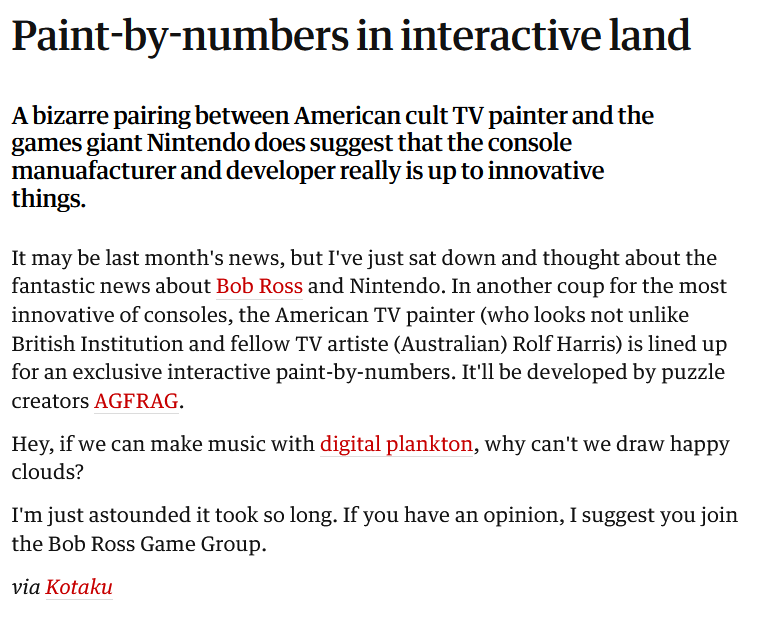
Engadget broke the news with characteristic enthusiasm, reporting that "The Joy of Painting" was coming to the Revolution (the Wii's development codename) and DS. The story was picked up and amplified across the gaming press.
IGN's Matt Casamassina contacted Hatcher directly for clarification on whether the announcement was an April Fools' joke. Hatcher's response revealed both his awareness of the timing and his ambitions: "The press release is not a joke, but the side effect of people thinking it is might help us get noticed." He also confirmed that AGFRAG had secured the licence "just before the Game Developers Conference" and was planning a publisher announcement at E3 2006 in Los Angeles.
A forum user who contacted AGFRAG directly in April 2006 received a personal email reply from Joseph Hatcher — the same statement later published by IGN — and separately received confirmation from a Bob Ross Co. representative: "At this time, plans to produce a Bob Ross Video Game are in preliminary stages; we'll post more information on our website as details become available." This dual confirmation from both the developer and the IP holder left no doubt that the announcement was genuine.
Ars Technica covered the art contest that AGFRAG launched to promote the game, inviting fans to submit their own Bob Ross-style paintings. It was a clever marketing move that engaged the Bob Ross community directly.
GameZone confirmed the DS version specifically, noting AGFRAG's commitment to bringing the painting experience to the handheld's touchscreen. NintendoWorldReport, Shacknews, GoNintendo and GameSpot all ran stories. The international press picked it up too — Japanese outlet Inside Games and Thai media covered the announcement.
The announcement even reached college campuses. The Daily Free Press, Boston University's student newspaper, ran a satirical opinion column in April 2006 mocking the concept — a backhanded testament to how widely the story had spread beyond the gaming press.
For a game from a tiny studio that had never shipped a major console title, this was extraordinary coverage. Bob Ross's name opened doors that AGFRAG's reputation alone could not have.
The Art Contest
One of the most interesting promotional efforts was the art contest. AGFRAG invited Bob Ross fans to submit their own paintings — not digital, but real oil paintings done in Ross's style — for a chance to have their work featured in the game.
This was a shrewd move on multiple levels. It generated media coverage (Ars Technica's article specifically covered the contest). It engaged the Bob Ross fan community. And it demonstrated that AGFRAG understood what made Ross special: it wasn't about the final painting, it was about the experience of painting.
The contest also served as an unofficial proof of concept. If thousands of people were willing to paint a Bob Ross landscape and submit it to a video game company, there was clearly demand for the product. The community existed. The passion was real.
Why It Was Cancelled
The game was never released. The exact reasons were never fully disclosed, but the broader context tells a clear story.
In 2006, developing for Nintendo hardware was expensive and complex. Console development required official developer kits, licensing agreements, quality assurance testing and compliance with Nintendo's technical standards — all of which cost money. For a small studio without a publisher or significant funding, these costs could be prohibitive.
The Wii, in particular, presented a unique challenge. Its motion controls were revolutionary but also notoriously difficult to develop for. Translating the subtle movements of painting — the pressure of a brush, the angle of a palette knife, the controlled gesture of a happy little tree — into reliable motion-control inputs was a significant technical challenge, even for larger studios.
There was also the licensing complexity. Bob Ross Inc., controlled by the Kowalski family, managed Ross's intellectual property with significant legal oversight. Maintaining a licensing agreement while navigating development delays and funding shortfalls added another layer of difficulty.
NintendoWorldReport reported at the time that the developer had "left the project," suggesting that AGFRAG itself stepped away rather than being forced out. For a passion project by a small team, the gap between concept and commercial product may simply have been too wide to bridge without external funding or a publishing partner.
In December 2006, the situation became clearer. A message appeared on the game's Yahoo Group, the primary online community where fans had been following development updates. The statement was brief and unambiguous: "AGFRAG is no longer involved in the development of ANY Bob Ross Game. Please contact Bob Ross Inc. for further information." The emphasis on "ANY" — present in the original message — suggested a complete and definitive separation, not a pause or restructuring.
GameSpot followed up by contacting Joseph Hatcher directly for comment. Hatcher confirmed the news in measured terms: "We will not be developing the game on any platform." When pressed for details about what had gone wrong, Hatcher cited legal reasons for not being able to elaborate on the decision. He did, however, leave one door slightly ajar: "We are not saying it is canceled in anyway" — a carefully worded statement that hinted the Bob Ross license might find another developer, even if AGFRAG would not be the one to carry it forward.
Shortly after the GameSpot story ran, Hatcher posted a more personal message on the AGFRAG website: "I'm sorry that we have disappointed so many people on a certain project. Please realize we did what we felt was best, with the cards that were dealt to us and the situation we were in. We have learned from the experience and we won't make the same mistakes twice. The companies we dealt with were professional in every way and we enjoyed working with them while we did and appreciated the opportunities they presented to us. You won't hear anything about our next game until it's almost on shelves." It was a rare moment of candor from the studio — an acknowledgment that the project had not ended on AGFRAG's terms, and that the experience had been a painful one. The final line, in particular, revealed how deeply the public scrutiny of the Bob Ross project had affected Hatcher's approach: next time, there would be no announcements until the product was ready.
Contemporary reports suggest it was Bob Ross Inc. that ultimately ended the relationship, dropping AGFRAG from the project in December 2006 and beginning a search for a new developer. This explains why Hatcher carefully avoided saying the game itself was cancelled — because from AGFRAG's perspective, it wasn't. The concept still existed; they simply were no longer attached to it. No new developer was ever announced, and the game quietly faded from public consciousness.
Ahead of Its Time
Here's the thing about the Bob Ross game: the concept wasn't wrong. It was early.
Consider what happened in the following years:
- 2011: Procreate launched on the iPad, using touch and stylus input to create a natural painting experience — essentially what the DS version of the Bob Ross game aimed to do.
- 2013: Art Academy: SketchPad released on the Wii U, a first-party Nintendo painting game using the GamePad's touchscreen.
- 2015: Twitch's Bob Ross marathon drew 5.6 million viewers, proving the massive demand for Ross-related interactive content.
- 2019: "Bob Ross: The Joy of Painting" mobile app launched, offering a simplified version of what AGFRAG had envisioned.
- 2020: "Bob Ross: Happy Accidents, Betrayal & Greed" Netflix documentary renewed interest in Ross's legacy.
Every element of AGFRAG's vision — painting with motion controls, touchscreen art tools, guided creative instruction, Bob Ross as a virtual tutor — eventually came to exist in some form. The technology caught up. The market developed. The demand was always there.
AGFRAG was simply three to five years too early, with too few resources, targeting hardware that wasn't quite ready for the experience they wanted to create.
The Wikipedia Footnote
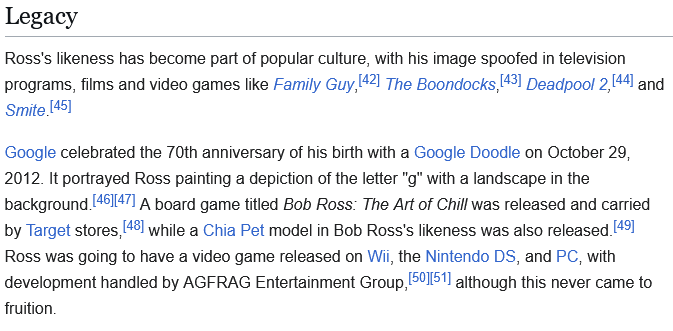
The AGFRAG Bob Ross game lives on in one notable place: Bob Ross's Wikipedia page. In the Legacy section, the encyclopedia records:
"Ross was going to have a video game released on Wii, the Nintendo DS, and PC, with development handled by AGFRAG Entertainment Group, although this never came to fruition."
It's a single sentence — a footnote in the cultural history of one of America's most beloved figures. But it captures something important: the idea was significant enough to be remembered. In the long list of cancelled video games, most are forgotten entirely. The Bob Ross game persists because the concept resonated.
Could the Game Still Exist Somewhere?
One question lingers: did AGFRAG produce anything playable before the project was shelved? The answer is almost certainly yes — at least in prototype form.
Game development typically follows a pipeline: concept documents, then a proof-of-concept prototype, then a vertical slice (a polished segment demonstrating the core gameplay), then full production. Given that AGFRAG had secured the license, announced the game publicly, launched an art contest and received coverage from major outlets, the project had progressed well beyond the concept stage. A working prototype — even if rough — would have been necessary to demonstrate to both Bob Ross Inc. and potential publishers.
Whether that prototype still exists is unknown. Joseph Hatcher, AGFRAG's founder, maintained the studio's trademark and periodically updated the agfrag.com domain into the early 2020s. If development assets — code, art, design documents, audio recordings of Bob Ross — were preserved, they would represent a genuinely unique artifact of gaming history.
The gaming preservation community has successfully recovered prototypes and builds of cancelled titles before. Projects like the Video Game History Foundation and Archive.org's software preservation efforts have rescued countless lost games from obscurity. The Bob Ross game, with its unusual concept and cultural significance, would be a particularly interesting recovery — not just as a playable curiosity, but as a document of early attempts to merge fine art with interactive technology.
If anyone connected to the original AGFRAG team has information about surviving development materials, we'd love to hear about it. History deserves to be preserved — even the history of things that never quite happened.
The story was not entirely forgotten. In June 2013, a fan in Canada launched a Change.org petition addressed directly to AGFRAG Entertainment Group, calling for the game to be made. It gathered only 13 signatures before closing — a modest number that nonetheless illustrates both the enduring appeal of the concept and the fact that, seven years after the announcement, many fans still believed AGFRAG might be the studio to bring it to life.
What the Project Tells Us
The AGFRAG Bob Ross game is more than a curiosity in gaming history. It's a case study in several themes that remain relevant today:
Creative tools as entertainment. The game's core insight — that the act of creating art can be entertaining, not just productive — anticipated the entire creative gaming genre, from Minecraft to Mario Maker to Dreams.
The importance of timing. A great concept on the wrong hardware at the wrong time will fail. The same concept, five years later, might succeed spectacularly. Procreate succeeded where the Bob Ross game couldn't — not because the vision was different, but because the technology and market conditions had matured.
The value of accessible creativity. Bob Ross's philosophy — that everyone can create art — was radical in the 1980s and remains powerful today. Every creative tool that lowers a barrier, every platform that makes art more accessible, carries a piece of that philosophy. AGFRAG understood this in 2006, and it remains the defining idea of the digital creativity movement.
Sources
Frequently Asked Questions
Was any version of the Bob Ross game actually completed?
No complete version was ever finished. According to industry sources, AGFRAG Entertainment Group had working prototypes demonstrating basic motion control painting mechanics, but these were proof-of-concept builds rather than full games. The most advanced version reportedly included 2-3 complete painting lessons with basic Wii Remote brush simulation.
Could the game still be developed today with modern technology?
Absolutely. Modern hardware and software development tools would make the Bob Ross game concept much more feasible today. Current VR systems like the Oculus Quest offer precise motion tracking that could handle realistic brush physics. Tablet devices with pressure-sensitive styluses provide natural drawing interfaces.
What happened to AGFRAG Entertainment Group after the cancellation?
AGFRAG Entertainment Group continued operating as an independent studio after the Bob Ross project cancellation. The studio shifted focus to smaller-scale projects and worked on several mobile games and educational applications throughout the late 2000s.
How would the game have compared to actual Bob Ross painting lessons?
The game would have included Ross actual voice recordings providing step-by-step guidance, similar to his TV format but adapted for interactive pacing. The key difference would have been immediate feedback and error correction, potentially making it more effective than passive video for some learning styles.
Technical Innovation Analysis
The Bob Ross game represented several technical innovations that were genuinely ahead of their time. Creating realistic paintbrush physics using the Wii Remote required solving problems that would not become standard until years later.
This involved complex calculations including brush pressure simulation based on movement speed, stroke width variation based on movement direction, and paint blending algorithms that could process in real-time. Modern digital art applications like Procreate and Adobe Fresco solve similar problems, but they benefit from much more powerful hardware and a decade of additional research.
The project anticipated by several years the emergence of creativity-focused gaming experiences. Nintendo Art Academy series first released in 2009 shares obvious similarities with AGFRAG Bob Ross concept. The project also predicted the rise of instructional gaming - games designed primarily to teach real-world skills rather than provide entertainment.
- GameSpot — Bob Ross painting DS, PC, Revolution (April 2006)
- The Guardian — Paint by Number (April 2006)
- Engadget — The Joy of Painting coming to Revolution and DS (April 2006)
- Engadget/Joystiq — Bob Ross painting on the Revolution?! (March 31, 2006 — first coverage)
- IGN — Bob Ross Paints on Revolution (April 2006)
- Engadget/Joystiq — Joy of Painting to be unleashed on the happy little DS (April 2006)
- GoNintendo — Bob Ross developer talks about Wii/DS game (May 2006)
- Ars Technica — AGFRAG art contest coverage (May 2006)
- Engadget/Yahoo News — Interview with Joseph Hatcher on the Bob Ross game (May 2006)
- GameSpot — Wii, DS, PC Bob Ross game dries up? (December 2006)
- MTV News — Video Game Based On Bob Ross' Joy Of Painting In The Works (April 2006)
- Nintendo World Report — Bob Ross Game Canceled? (December 2006)
- GameFAQs — Bob Ross Painting (DS) — official game entry, listed as Canceled
- RPGnet Forums — Bob Ross Videogame discussion (December 2007)
- Change.org — Bob Ross the video game petition (June 2013)
- Wikipedia — Bob Ross (Legacy section)
This Domain's Story
agfrag.com was AGFRAG Entertainment Group's home on the web. After the studio wound down its operations, the domain changed hands several times before becoming available in early 2026.
We chose to build BrushBit here — a publication about digital creativity, art and technology — because the domain's history aligns perfectly with the stories we want to tell. AGFRAG tried to bridge the gap between art and interactive technology. That's still the most interesting conversation in digital culture, and it's the one we explore every day.
For the full history of AGFRAG Entertainment Group and this domain, see our dedicated history page.
See also: Complete List of Cancelled Video Games →